
Data for Decisions: How EcoFoodSystems is Supporting Food System Stakeholders’ Decision Making in Hanoi
Ciara Varley, Nhung Tuyet Vuong, Anna Lorente Sebastián, Peter C. McKeown, Charles Spillane.
Hanoi, Vietnam – 14th and 15th April 2026 – EcoFoodSystems held a consultation meeting with Hanoi stakeholders to review the City Regional Level Food Systems Decision-Support Dashboard being developed by the programme.

Search online for information about food systems and you will find no shortage of knowledge. Although policy briefs, cutting-edge research papers and datasets abound, for stakeholders working in Hanoi city region, finding the right information at the right time remains a challenge.
Dashboards might provide a solution to some of the difficulties faced by food system stakeholders looking for data and recommendations that can inform their decision making. Dashboards – which are a visual, often interactive tool that allow users to visualise data sets in different ways – have been identified as a practical and useful tool for people using data to make decisions.
The potential for dashboards to support decision-making has led to the creation of different dashboards for food system stakeholders. While existing national and global food system dashboards provide useful insights at a high-level, dashboards with the granularity needed to tackle the unique problems facing cities remain absent.
EcoFoodSystems Holds Project Stakeholder Dashboard Co-Development Meeting


It is perhaps no surprise, then, that stakeholder recommendations emerging from the EcoFoodSystems project’s inception consultation placed a focus on developing a city-regional food system dashboard for Hanoi city.
Following on from a 2025 dashboard consultation with experts in Addis Ababa, EcoFoodSystems and food system experts working in Hanoi met together in the city to comment and critique the latest edition of the EcoFoodSystems City Regional Level Food Systems Decision-Support Dashboard.
The two-day consultation was held by the Rikolto and University of Galway teams of the EcoFoodSystems project, in collaboration with the Centre for Agrarian Systems Research and Development (CASRAD), a key member of the Vietnam Academy of Agricultural Sciences (VAAS) and leading contributor to Vietnam’s National Action Plan to Transform a Transparent, Responsible, and Sustainable Food System by 2030.
Framing discussions of the day were opening remarks from food system experts working across Hanoi city. Opening remarks were provided by esteemed speakers:
- Dr. Vu Thi Hang, Deputy Director General of the Department of Science and Technology at the Ministry of Agriculture and Environment, who spoke on the key priorities for Resolution No. 57/NQ-CP on Science and Technology Development, including the role of digital technology and policies in enabling food system transformation.
- Dr. Trinh Van Tuan, Director of CASRAD, spoke to the need to transform data into actionable outcomes for food system stakeholders working in Hanoi, highlighting that the challenge lies not in a lack of data, but in the ability to use available data effectively to support decision-making.
- Assoc. Prof. Dr. Dao The Anh, President of the Vietnam Rural Development Science Association (PHANO), highlighted the interdisciplinary nature of agrifood systems and the critical need for cross-sector collaboration.
- Assoc. Prof. Dr. Tran Minh Tien, Vice President of the Vietnam Academy of Agricultural Sciences, outlined the critical role of stakeholders in implementing the National Action Plan under Decision No. 300.
- Assoc. Prof. Dr. Truong Tuyet Mai, Vice Director of the National Institute of Nutrition, discussed the importance of strengthening the linkages between Vietnam’s agriculture and health sectors to promote sustainable food systems. transformation.
- Dr. Le Tran Phong, Deputy Head of the Division of Science and Intellectual Property at the Hanoi Department of Science and Technology, placed the focus on consumers in Hanoi, speaking to consumers’ growing desire for green and environmentally friendly food products.
- Dr. Peter McKeown, Lecturer at the Univesity of Galway and Head of the EcoFoodSystems Project, underlined the need to integrate and effectively utilise data from multiple sources to support decision-making, an outcome the EcoFoodSystems project is supporting through creation of the EcoFoodSystems City Regional Decision-Support Dashboard.
- Dr. Vu Thi Hang, Deputy Director General of the Department of Science and Technology, Ministry of Agriculture and Environment, emphasised the role of science, technology, and policy in sustainable food systems transformation, referring to the strategic directions outlined in Resolution No. 57/NQ-CP, particularly those regarding digital transformation and international cooperation.
Sustainable Food Systems in Hanoi: Insights from Huong Viet Sinh Co., Ltd and Agroeconvert Project
Experts in attendance then heard from two keynote speakers.
Mr. Do Van Hoa, Director of Services of Huong Viet Sinh Co., Ltd, presented ‘Climate-Resilient Ecological Food Systems Transformation’, sharing insights on Huong Viet Sinh Company’s contribution to Hanoi’s food system. The company specialises in providing school meal services for more than 200 schools in Hanoi and surrounding areas. To meet food traceability and quality control needs, the organisation has developed a ‘From Farm to Table’ closed-loop supply chain model. Under the model, the company has established farms in Bac Ninh and Moc Chau, where safe farming practices are being used to grow foods used in school meals, strengthening quality management and food safety control.
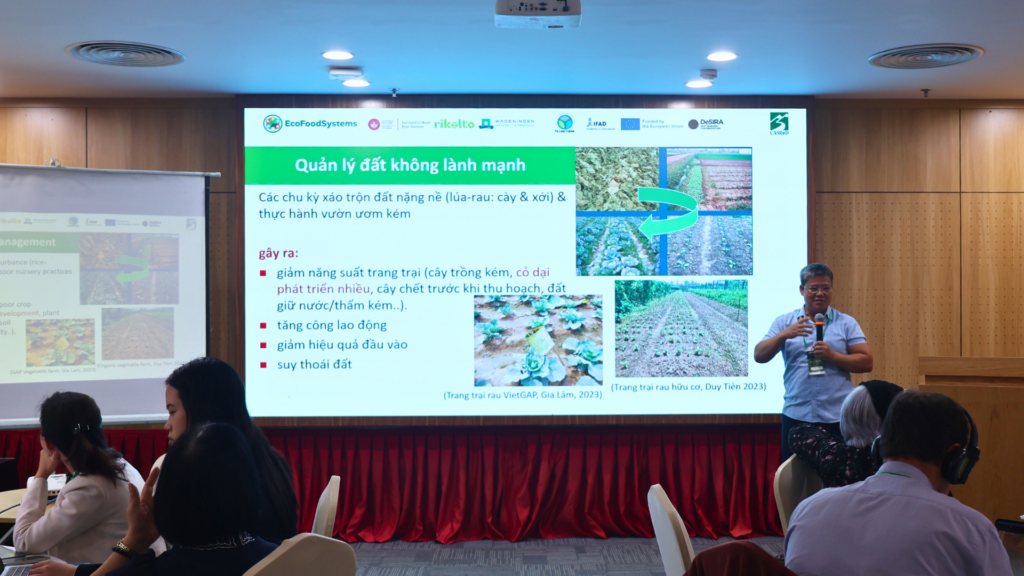
Dr. Pham Van Hoi of Vietnam National University of Agriculture presented ‘Agroecological practices & sustainable vegetable production in Hanoi’, providing findings from the Agroeconvert project. Dr. Hoi’s emphasised the need to promote innovative agroecological solutions, strengthen resource recycling, improve soil quality, and enhance production efficiency to support agroecological transitions of Hanoi’s food system.

Stakeholders Lead Next Steps for the Hanoi City-Regional Dashboard
The second iteration of the dashboard was then shown to 40 food system experts working across government, NGOs, private sector, academia, research, and development sectors in Hanoi. The dashboard, which offers an expertly curated pick n’ mix of data and indicators related to food systems, was revaiewed in detail by mixed groups of food system experts.
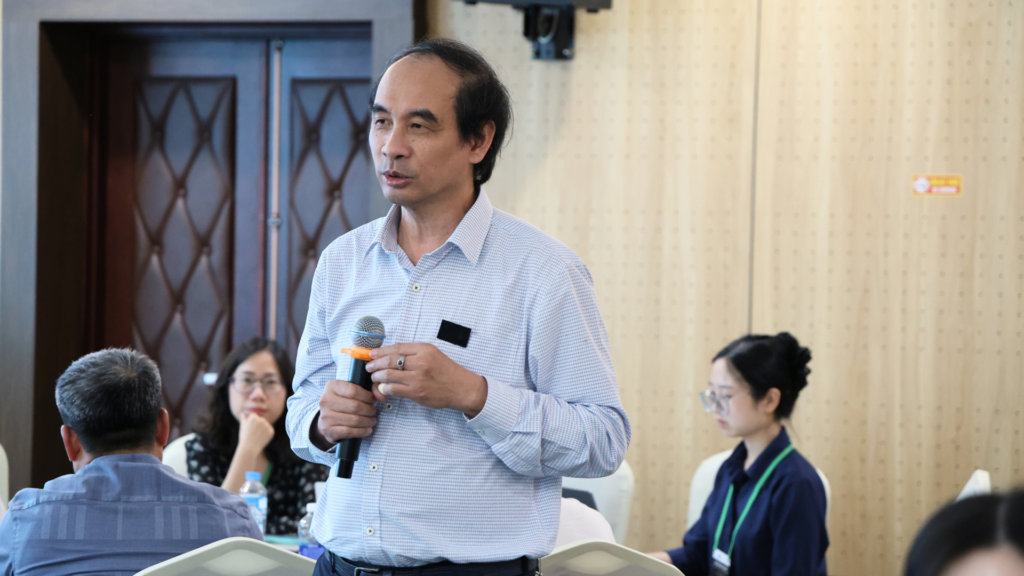


Expert participants reviewed the dashboard across key criteria including usability, structure, usefulness of the included food system indicators and datasets, future use cases, and best next users, among others. Discussions pointed to the impact the dashboard, which will ultimately be adopted by a key national stakeholder, can have for decision-making in future.
What’s Next for the EcoFoodSystems City-Regional Dashboard?
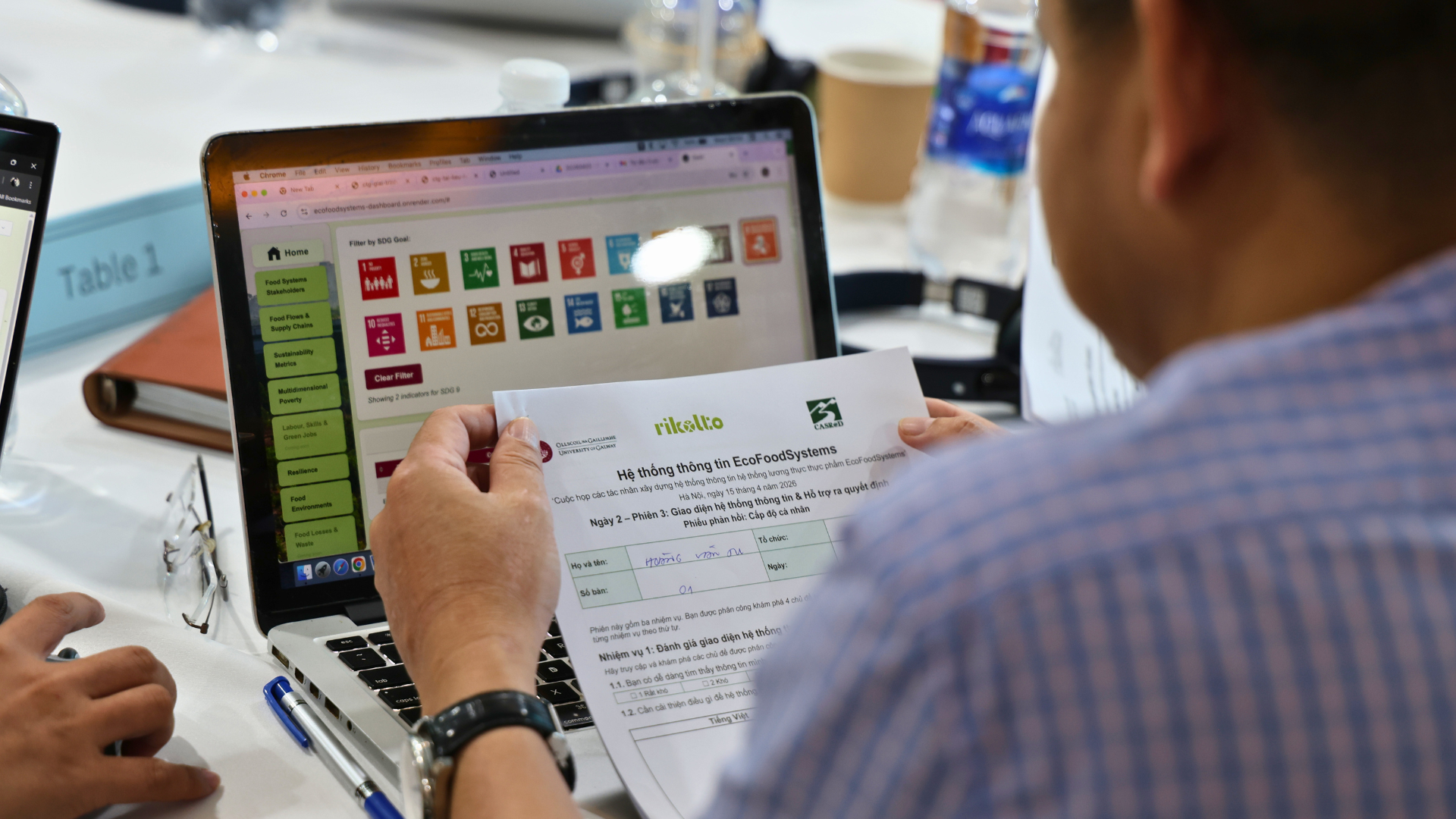
These findings are being used directly by the EcoFoodSystems team for creation of the next prototype of the dashboard. The EcoFoodSystems City-Regional Dashboard continues to be developed by researchers working on the tool: Jemima O’ Farrell, Yared Tessema, Shamilah Nassozi, Ky Hoang, Dawit Chekol, Minh Duc Tran, Carlos Rodriguez Plaza and Vibeth Porras Gonzalez.
The EcoFoodSystem project extends thanks to the International Fund for Agricultural Development (IFAD) for funding of the project and this consultation meeting through the EU DeSIRA initiative, and to the Centre for Agrarian Systems Research and Development (CASRAD) for their support in running this consultation. As the EcoFoodSystems project enters its final phase of research and implementation, the team look forward to working with stakeholders to create a city-regional food system dashboard worth its salt.