

Researcher Reflection: EcoFoodSystems at the Global Bioeconomy Summit
By: Angharad Johnston |
The blog below is a reflection from EcoFoodSystems researcher, Angharad Johnston, about her time at the Global Bioeconomy Summit in Dublin, Ireland.
I am one of the privileged many who attended the Global Bioeconomic Summit in Dublin last week, 21st and 22nd of October, showcasing homegrown and international ideas, innovations and strategies to transition national and regional economies to sustainable and equitable modus operandi. I was proud to see Ireland picking up the gauntlet from Kenya who hosted the summit in Nairobi in 2024.

The day’s session was opened by the Taoiseach of Ireland, Micheál Martin; Minister for Agriculture, Food and the Marine, Minister Martin Heydon; and Minister for Climate, Energy and the Environment, Minister Darragh O’Brien, with a bold and optimistic tone for Ireland’s leadership in Bioeconomic Development across Europe and beyond.
I have come away invigorated for my own research within the EU’s DeSIRA-funded and IFAD-managed EcoFoodSystems project, looking at how Ethiopia can and should implement its recently launched National Bioeconomic Strategy to deliver financial, legislative and capacity-building innovations that reorient food loss and waste as high value feedstocks for its nascent insect farming industry.
Plenary session 3 ‘Supercharging the Bioeconomy: Policy, Markets and Metrics to Scale Biobased Solutions’ brought together perspectives from Africa, China and India, with a stacked panel from academia, the private sector and independent think-tanks. Each shone light on the role of industrial policies and incentives in scaling scienced backed bio-based solutions and innovations.
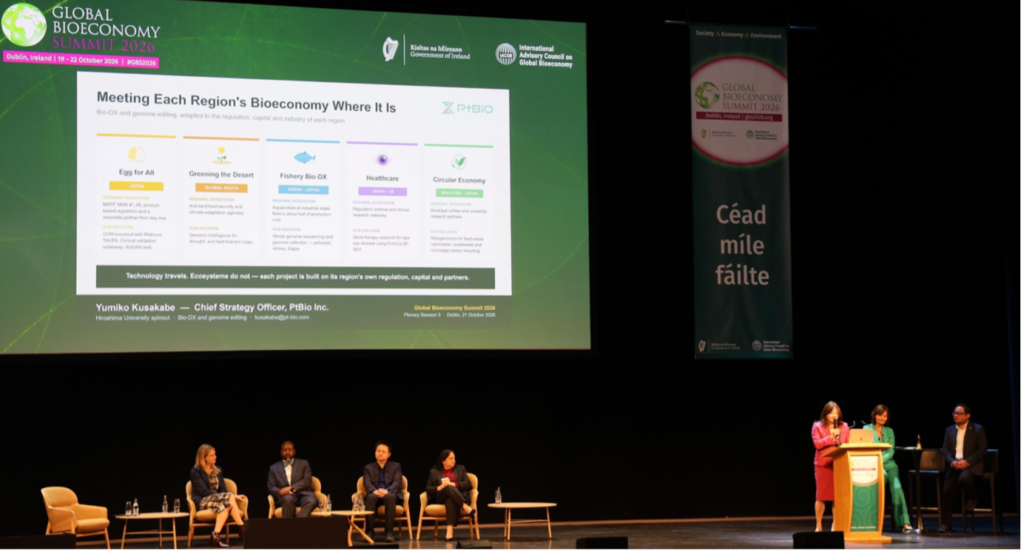
Panellist Debisi Araba, Managing Director of Akademiya2063, highlighted the $400 billion infrastructure gap in Africa, in response to which the African Development Bank launched the New African Financial Architecture for Development (NAFAD) capital coordination framework. At least 12 African nations have now formulated dedicated bioeconomy strategies, with South Africa, Ethiopia, Namibia, and Kenya leading the way, and the NAFAD ensures these national trailblazers are supported by regional strategies like the 10 year Comprehensive Africa Agriculture Development Programme (CAADP),as well as the longer term strategies like the Agenda 2063 roadmap.
Focusing back to Ireland, I was lucky enough to participate on Day 2 of the Summit in an interactive workshop deftly run by a team from across University College Cork and Maynooth University ‘Scaling Circularity: Integrating Urban Waste biorefineries (UWBs) into the Global Bioeconomy, exploring the legislative, financial, technical and societal opportunities for reorienting textile and agricultural waste into high-value resources.
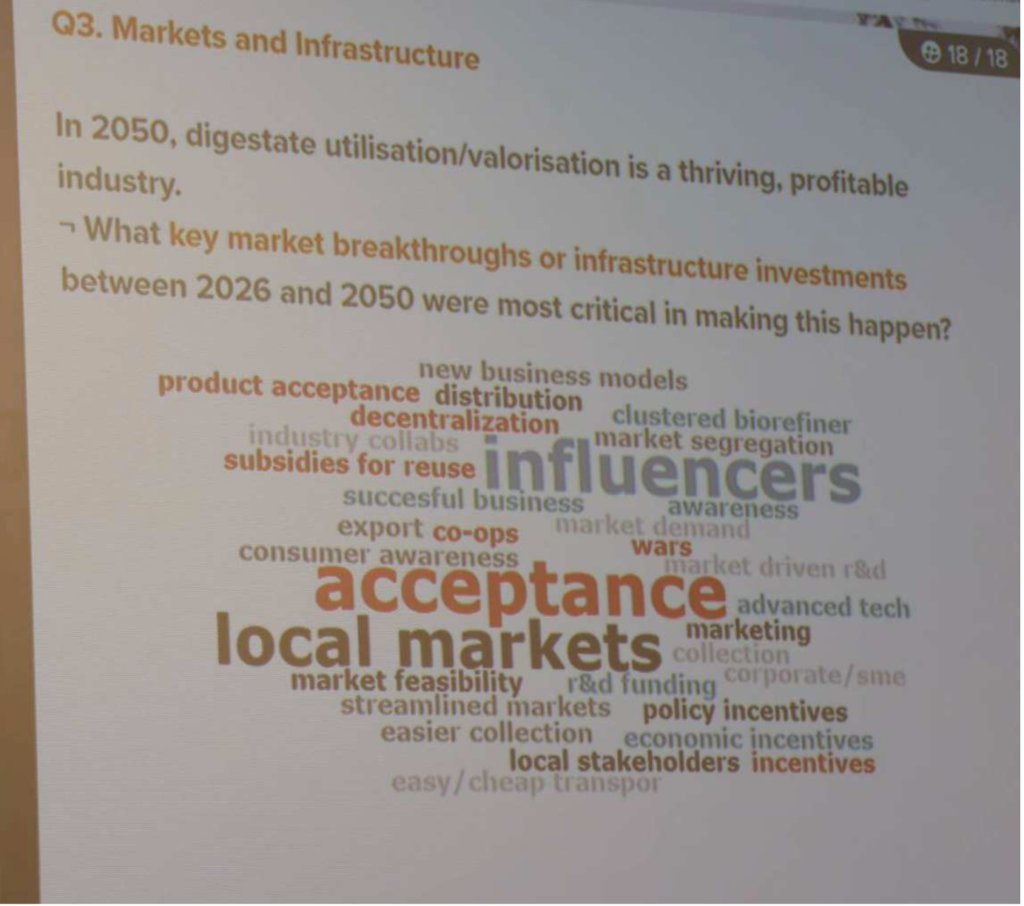
We were asked to imagine ourselves in 2050, enjoying a thriving circular and sustainable bioeconony in Ireland, and reflect back on 25 years of technical advances, political decisions, market dynamics and societal norms. Delightfully, many described seeing the vast landscape of influencer culture taking up the mantle of endorsing digestates – a nutrient-rich residual valorised from primary bio-waste feedstocks – as a pivotal market driver. All in attendance were joined together in witnessing the conception of an ‘Effluent-cer’.
As a final triumph for the summit, Ireland launched yesterday its first-ever national Bioeconomy strategy BioScale2030, coinciding with the GBS2026, mapping out a national framework to scale up local sustainable industries using biological resources.
I will be forever grateful to have been part of this monumental event for Ireland, and for the opportunity given to me by the EU’s DeSIRA program in funding my own research, enabling me to contribute to the next global revolution for bioeconomic development.
The EcoFoodSystems project is funded by the European Union DeSIRA initiative with management support from the International Fund for Agricultural Development (IFAD).