
How Vietnam and FAO are Strengthening Vietnam’s Agrifood System Transformation Agenda
Ky Hoang, Ciara Varley, Peter C. McKeown, Anna Lorente Sebastián.
July 28th–29th, 2026 – Hanoi, Vietnam – The Ministry of Agriculture and Environment, Vietnam, and the Food and Agricultural Organisation of the United Nations held a workshop in Hanoi to align Vietnam’s National Action Plan for Food Systems with the FAO’s Global Roadmap: FAO SDG-2 Global Roadmap for Food Systems Transformation. EcoFoodSystems attended the days’ events.
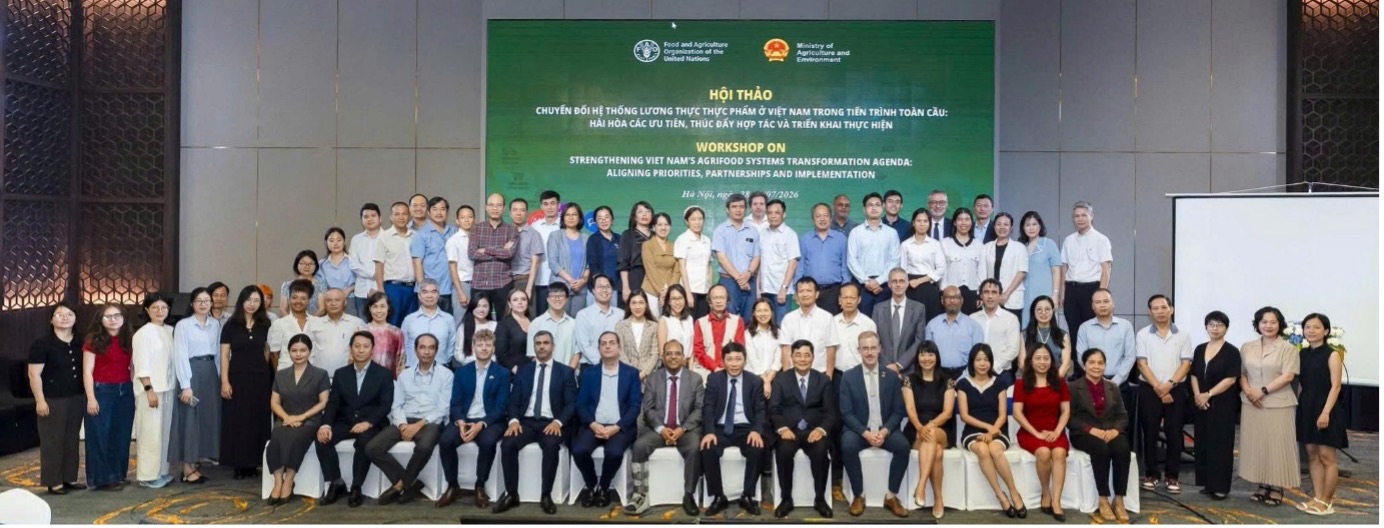
The Ministry of Agriculture and Environment (MAE) in Vietnam and FAO in Vietnam recently convened a national workshop, “Strengthening Viet Nam’s Agrifood Systems Transformation Agenda: Aligning Priorities, Partnerships, and Implementation”, in Hanoi.
The two-day event brought together a range of representatives spanning businesses, development partners, international organisations, research institutions and government to discuss how the FAO SDG-2 Global Roadmap for Food Systems Transformation can align with Vietnam’s National Action Plan for Transparent, Responsible and Sustainable Food Systems Transformation by 2030 (Decision 300/QD-TTg). Representing the EcoFoodSystems project across the two days was University of Galway and Rikolto EcoFoodSystems researcher Ky Hoang.
The workshop marked an exciting point in Vietnam’s continuing journey to further sustainable and resilient agrifood systems across the country. The workshop aimed to support further progress under the National Action Plan for Transparent, Responsible and Sustainable Food Systems Transformation by 2030 by bringing stakeholders together to map key national policies and actions occurring in Vietnam.
Opening the event was Dr. Nguyen Do Anh Tuan, Director General of the International Cooperation Department. Dr. Nguyen highlighted Vietnam’s shift from focusing on food volume to pursuing “multi-value” production that is green, safe, and low on emissions.
Following opening remarks, stakeholders worked together across the two days to map 103 national policies against 120 global actions. Participants in attendance identified 41 high-priority tasks needed to ensure that Vietnam’s food system transformation continues to be transparent, responsible, and sustainable.
For Ky, one standout from the workshop was the policy review presented by Dr. Cao Duc Phat, the former Minister of Agriculture and Rural Development. Dr. Phat’s team have found that, while Vietnam’s nutrition targets are often more ambitious than global benchmarks, there is still a significant need to accelerate climate-related goals in Vietnam.
Five food system priorities in five years
To meet these challenges, attendees of the event considered together the top priorities for food system transformation in Vietnam. 53 partners currently implementing over 260 projects across the country honed hundreds of ideas down to five key priority areas for 2026-2030.
- Modern governance: Strengthening legal frameworks and food safety standards.
- Green production: Transitioning to agroecological and low-emission farming.
- Resource management: Improving the sustainable use of land and water.
- Digital transformation: Scaling up big data, traceability, and early warning systems.
- Investment: Mobilising domestic and international resources for a “Net Zero” transition.
EcoFoodSystems were interested to see the ideas that emerged from the discussions. Many of the priorities identified reflect the project’s own aims and objectives, such as supporting better decision-making through developing digital tools and researching agroecological approaches to food system transformation efforts.
Another step forward for Vietnam’s food system
The workshop findings will ensure that future research and investments continue working collaboratively to make real, tangible contributions to Vietnam’s food system transformation strategy. One notable insight from discussions at the event was the role collaboration between FAO and the Ministry of Agriculture and Environment can play in supporting Vietnam’s food system transformation initiatives.
Dr. Vinod Ahuja, FAO Representative in Vietnam, highlighted how alignment of the FAO Global Roadmap with national level policies in Vietnam can play an important part in supporting food system transformation efforts. He said:
“The FAO Global Roadmap will serve as a vital tool to help Viet Nam identify policy gaps and pinpoint the key leverage points needed to drive transformation across the entire agrifood system”.
For EcoFoodSystems, one of the biggest takeaways from the workshop was the role collaboration can have in creating real impact on the ground. EcoFoodSystems has seen this benefit first-hand. The project’s work with the Center for Agrarian Systems Research and Development (CASRAD), National Institute of Nutrition (NIN) and others has helped shape research direction and outcomes, providing critical direction on EcoFoodSystems initiatives such as the EcoFoodSystems City-Regional Food Systems Decision-Support Dashboard, gamification interventions, climate resilience mapping, and more.
The EcoFoodSystems project extends thanks to IFAD for funding of the project through the European Union DeSIRA initiative. This funding supports EcoFoodSystems research and attendance at key policymaking events such as these, contributing to food system discussions at the national level.